

How To Draw Up Mg In A Cc Syringe
The descriptions beneath are full general in nature and may not apply in all cases. It's ever important to read the customized instructions that come with a syringe. It might be helpful to exercise with obviously water until you feel comfortable and familiar with handling and using a syringe.

1. Parts of a syringe
A syringe is made up of three parts: the tip, the barrel, and the plunger.
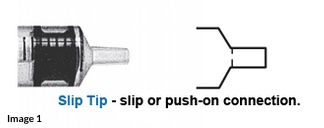
The tip of the syringe is where a needle is sometimes attached. People tapering off psychiatric drugs typically use a sideslip tip syringe, shown above in the image, always without a needle.
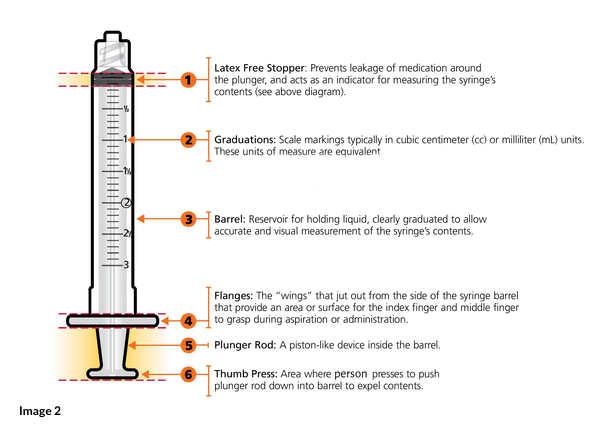
In the image above (not a slip tip syringe), the barrel (#3) is the reservoir that holds liquid. Information technology is graduated with lines (#2) that are typically printed or etched on its surface and calculated in cubic centimeter (cc) or milliliter (mL) units. These units of measurement—cc and mL—are equivalent.
The plunger (#5) is a piston-type rod that moves upwardly and down inside the butt when the plunger is pushed or pulled using the thumb press (#half dozen) and flanges (#iv). At the end of the plunger is a slightly cone-shaped plunger tip (#1). This is what prevents leakage of liquid effectually the plunger. The plunger tip is too the indicator for measuring the volume of the syringe'due south contents.
ii. Operating a syringe
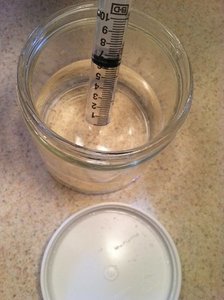
To operate a syringe, showtime make sure the plunger is pressed down to the bottom of the barrel. Then, place the tip in the liquid that yous want to measure. Draw dorsum on the plunger and the liquid will menses into the syringe, as demonstrated in the prototype above. The markings on the side of the syringe indicated how much liquid you have drawn in.
3. Agreement the units of measurement on a syringe
Depending on the capacity of a syringe, its principal measurement-line markings may exist in milliliters (e.g. 1mL, 2mL, 5mL, etc.) or fractions of a milliliter (e.m. 0.1mL, 0.2mL, 0.5mL, etc.). The larger the capacity of the syringe, the more than space there will be in between the measurement lines. As a reminder, mL and cc are equivalent units of measurement when reading the plunger.
Syringes with markings in decimals are optimal. If a syringe uses fractions, they'll have to exist converted to decimals for near taper-related calculations.
To catechumen fractions to decimals, you simply split up the number on the summit of the fraction by the number on the bottom. If you don't like long division, it's easy to practice using an online or phone computer.
If a syringe has readings already in decimals, it'southward of import to locate the decimal signal and not to confuse any extra zeros before or later the principal number. The leading and trailing zeros before the decimal (i.east. 0.1) and after the last number (i.e. .10) are just placeholders. In other words,
0.1 = .one
.10 =.1
4. Reading the calibration markings
Here'southward how to read calibration markings on a syringe:
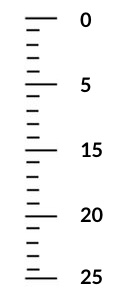
Determine the increment betwixt the visible numbers.
The visible numbers are next to the longer line markings on your syringe, as demonstrated in the image to the left. Decide what the increments between these major markings are. In this image, for example, the increment betwixt the larger markings is 5, or 5mL.
Determine the increments of the smaller markings.
Place your finger on one of the longer markings that has a visible number on your syringe, and so count the number of lines between it and on the adjacent side by side larger marking with a visible number. (In the case at the left, there are four smaller lines betwixt the 0mL marking and the 5mL marking.)
At present dissever the number of smaller lines past the amount of mL increase between the longer lines. This will tell you the amount of increment measured by the smaller lines.
In this image, 5mL divided past 5 smaller measurement lines = 1mL. So, each smaller marking on this syringe is equal to a 1mL increase.
Run across the figures below for other examples.
1mL syringe
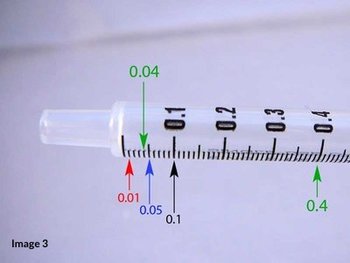
In the epitome above, the incremental amount betwixt the visible numbers is 0.1mL. There are ix smaller lines between each number. Since 0.i divided by ten is 0.01, this syringe allows accurate measurements equally pocket-size as 0.01mL (or one one-hundredth of an mL).
3mL syringe
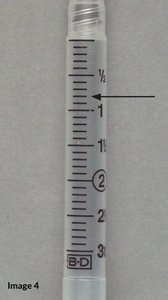
In the image above of this 3mL syringe, the smaller markings designate 0.1mL. These are the smallest-sized measurements you can make accurately with this particular syringe. The arrow is pointing to the 0.8mL (viii-tenths of a mL) marking.
five. Accurately measuring the corporeality of liquid in a syringe
Typically, the point where the plunger tip makes contact with the barrel is the spot to line upwardly with the amount of liquid being measured. Simply plunger types tin can vary across brands and thus may need to exist read slightly differently. Some plunger tips are plastic while others are rubber. Some are the same shape as the slip tip opening of the syringe, while others are flat, and still others domed.
Below are some full general tips from the layperson withdrawal community for how to read several different types of plunger tips.
Plastic plunger tip in the shape of the skid tip opening
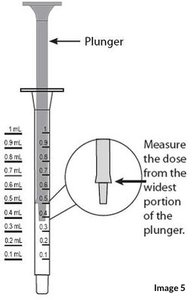
The image to a higher place shows a 1mL syringe with a plastic plunger tip in the shape of the skid tip opening. Every bit you can see, the dose is measured from the widest portion of the plunger tip—not from the end of the plunger tip. The image shows a reading of 0.5mL.
Flat rubber plunger tip
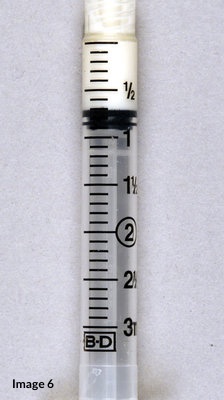
The epitome above shows a 3mL syringe containing liquid with a flat prophylactic plunger tip. For this particular syringe, the dose is measured by lining up the top ring of the safety plunger with the desired calibration mark on the barrel. The liquid amount in this syringe is vii tenths of an mL (Translating this into a decimal gives yous 0.7mL).
Domed plunger tip
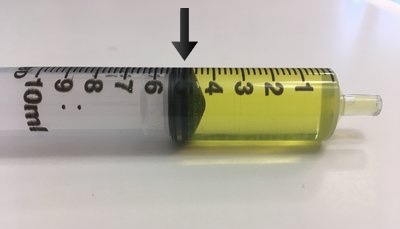
The image above shows a syringe with a domed plunger tip. The dose is measured by lining up the superlative band of the plunger tip with the 5mL calibration marking (where the arrow points). This means at that place is 5mL of liquid in this syringe. Do not use the tip of the dome or the lower band of the plunger tip when reading the corporeality of liquid in the syringe.
half-dozen. Boosted layperson tips for using syringes
- Always make sure the drug is evenly distributed in the liquid immediately before drawing liquid with the syringe.
- When putting the liquid for a liquid mixture or dilution in a jar, information technology may accept several full syringes worth of "pulls" to achieve the full corporeality. To obtain an accurate measurement, it's often recommended to apply a syringe that is large enough to avoid making more than 4 full pulls. (It can help to use hash marks or to push coins bated to continue track of the number of pulls from a syringe.)
- Afterwards apply, drawing water upwardly into the syringe tin can help gather any remaining drug residue that may be stuck to the barrel. This "rinse h2o" can and then be drank and appropriately included as office of the calculated daily dose.
- If the scale/calibration markings on a syringe are printed on the butt, covering the numbers with articulate packing tape can aid extend its life. Otherwise, the printed number markings may rub off apace with handling, making the syringes unreadable.
- If regularly using the aforementioned amount of diluting liquid in their main jar, some people find information technology helpful to create a permanent measuring mark for the right amount on the jar with marker covered by articulate packing tape, reducing the demand for syringes.
- Storing syringes in the fridge tin can help forbid mold growth.
- When cleaning syringes, many people pull the plunger completely out from within the barrel and leave the barrel and plunger separate to dry. (Notation: Some syringes practise not allow the plunger to exist removed.)
- If the syringe becomes difficult to plunge, some people have found it helpful to try dabbing a very small amount of coconut oil or olive oil on the edges of the plunger (where it connects with the plastic barrel internally) to lube it up. If this does not piece of work, they'll discard the faulty syringe and utilize a new 1.
- Some discover that liquids such as full-fat milk may bubble more if shaken when cold, which can touch the accuracy of measurements, so when using a syringe they let the liquid warm up first earlier making a cutting, or choose instead to stir vigorously rather than milk shake.
- Bubbles may sometimes announced in the barrel when pulling up liquid into their syringe. This tin can accept upwards infinite within the volume and pb to inaccurate measurements. Depending on which taper method being used, laypeople have found the following ways to manage this:
- If using a syringe to draw up liquid from a jar:
- With the plunger completely depressed within the butt, they stick the syringe into the liquid they're using.
- Making sure the tip is fully submerged, they then pull some liquid up into the syringe.
- Next, they button downward on the plunger equally far as it will go to push that liquid back into the container, while still being certain the tip of the syringe remains fully submerged in the liquid.
- With the syringe tip still submerged in the liquid, they pull upwardly the corporeality of liquid they need into the syringe slowly. This tends to prevent bubbles.
- If they draw up excess liquid using this method, they just push whatsoever excess back into the liquid jar until they take the correct amount needed remaining in the syringe.
- If using a syringe to draw up liquid through an Adapter Cap:
- With the syringe tip inserted into the adapter cap opening and the canteen of drug turned upside-downward, they draw into the syringe slightly more than drug than the amount required.
- If at that place are bubbling within the syringe, they flick the syringe with their finger, with the tip still inserted in the adapter cap opening and with the drug canteen nevertheless inverted.
- Typically, bubbles rise to the tip of the syringe, at which betoken it's possible to push the excess liquid, with the bubbles, back into the bottle until only the correct corporeality of liquid remains.
- If using a syringe to draw up liquid from a jar:
Image Credits:
Image 1 adapted and modified from Vitality Medical's 'Syringe Tip Option'.
Image two adapted and modified from BD's 'Anatomy of a Syringe'.
Paradigm three courtesy of RioReptiles.
Image 4 courtesy of Bertina Lynch, 'How to Read Syringes'.
Paradigm 5 courtesy BioPortfolio.
Image 6 courtesy of Bertina Lynch, 'How to Read Syringes'.
Prototype 7 courtesy of BD'south 'Anatomy of a Syringe'.

Source: https://withdrawal.theinnercompass.org/taper/using-syringes
Posted by: wilsonsirtho.blogspot.com
0 Response to "How To Draw Up Mg In A Cc Syringe"
Post a Comment