

How To Draw A Dog's Head
Proportions
Proportion says that two ratios (or fractions) are equal.
Example:

So 1-out-of-3 is equal to two-out-of-6
The ratios are the same, so they are in proportion.
Instance: Rope
A rope's length and weight are in proportion.
When 20m of rope weighs 1kg, and so:
- 40m of that rope weighs 2kg
- 200m of that rope weighs 10kg
- etc.
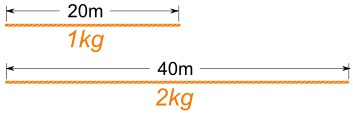
So:
twenty one = 40 2
Sizes
When shapes are "in proportion" their relative sizes are the same.
| Hither we see that the ratios of head length to trunk length are the same in both drawings. So they are proportional. Making the head too long or curt would look bad! | 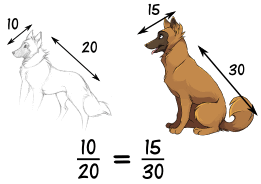 |
Case: International paper sizes (like A3, A4, A5, etc) all have the same proportions:
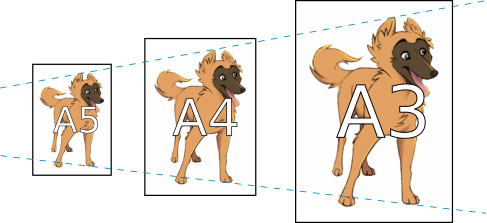
So any artwork or document can be resized to fit on any sheet. Very swell.
Working With Proportions
Now, how do we use this?
Example: you desire to draw the dog'south caput ... how long should it be?
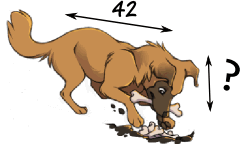
Let us write the proportion with the help of the 10/twenty ratio from higher up:
? 42 = 10 20
Now we solve it using a special method:
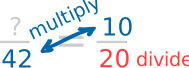
Multiply across the known corners,
so divide by the third number
And we get this:
? = (42 × 10) / 20
= 420 / 20
= 21
So you should draw the head 21 long.
Using Proportions to Solve Percents
A percent is actually a ratio! Saying "25%" is actually saying "25 per 100":
25% = 25 100
We tin can utilize proportions to solve questions involving percents.
The play a trick on is to put what we know into this form:
Part Whole = Percent 100
Case: what is 25% of 160 ?
The percent is 25, the whole is 160, and we want to find the "part":
Part 160 = 25 100
Multiply across the known corners, then separate by the 3rd number:

Part = (160 × 25) / 100
= 4000 / 100
= 40
Reply: 25% of 160 is xl.
Note: we could take also solved this by doing the divide showtime, like this:
Part = 160 × (25 / 100)
= 160 × 0.25
= 40
Either method works fine.
We can besides find a Percent:
Example: what is $12 as a pct of $80 ?
Fill in what we know:
$12 $80 = Percent 100
Multiply across the known corners, and then divide by the third number. This time the known corners are pinnacle left and lesser right:

Percent = ($12 × 100) / $80
= 1200 / 80
= fifteen%
Answer: $12 is 15% of $80
Or notice the Whole:
Example: The sale price of a telephone was $150, which was but eighty% of normal price. What was the normal price?
Fill in what nosotros know:
$150 Whole = lxxx 100
Multiply across the known corners, and so divide by the 3rd number:
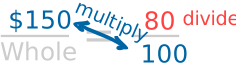
Whole = ($150 × 100) / 80
= 15000 / 80
= 187.50
Reply: the phone's normal cost was $187.l
Using Proportions to Solve Triangles
We tin can utilise proportions to solve similar triangles.
Example: How alpine is the Tree?
Sam tried using a ladder, tape measure out, ropes and various other things, just still couldn't piece of work out how tall the tree was.
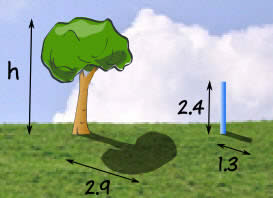
Simply then Sam has a clever thought ... like triangles!
Sam measures a stick and its shadow (in meters), and as well the shadow of the tree, and this is what he gets:
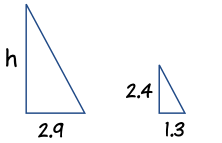
Now Sam makes a sketch of the triangles, and writes down the "Height to Length" ratio for both triangles:
Height: Shadow Length: h 2.9 m = two.4 m one.3 m
Multiply across the known corners, then separate past the 3rd number:
h = (2.9 × 2.4) / 1.iii
= 6.96 / 1.iii
= five.four m (to nearest 0.1)
Answer: the tree is 5.4 grand tall.
And he didn't even need a ladder!
The "Height" could have been at the bottom, and so long as information technology was on the bottom for BOTH ratios, like this:
Permit united states of america endeavour the ratio of "Shadow Length to Summit":
Shadow Length: Tiptop: 2.9 thousand h = 1.3 m 2.4 yard
Multiply across the known corners, then divide past the tertiary number:
h = (2.9 × 2.4) / 1.3
= 6.96 / 1.3
= 5.4 thousand (to nearest 0.1)
It is the same calculation as before.
A "Physical" Example
Ratios can have more than than ii numbers!
For example concrete is made by mixing cement, sand, stones and h2o.

A typical mix of cement, sand and stones is written every bit a ratio, such as 1:2:six.
We tin multiply all values by the same corporeality and still have the same ratio.
x:xx:60 is the same as 1:2:6
And then when nosotros use x buckets of cement, we should use 20 of sand and lx of stones.
Example: y'all take just put 12 buckets of stones into a mixer, how much cement and how much sand should you add to make a 1:ii:6 mix?
Allow u.s. lay it out in a table to go far clearer:
| Cement | Sand | Stones | |
|---|---|---|---|
| Ratio Needed: | one | 2 | half dozen |
| Y'all Have: | 12 |
You have 12 buckets of stones but the ratio says 6.
That is OK, you simply have twice as many stones equally the number in the ratio ... so yous need twice equally much of everything to go on the ratio.
Hither is the solution:
| Cement | Sand | Stones | |
|---|---|---|---|
| Ratio Needed: | ane | two | 6 |
| You Have: | two | 4 | 12 |
And the ratio 2:four:12 is the same as 1:2:6 (considering they show the same relative sizes)
So the answer is: add 2 buckets of Cement and 4 buckets of Sand. (You lot will as well need water and a lot of stirring....)
Why are they the same ratio? Well, the i:2:6 ratio says to have:
- twice as much Sand equally Cement (one:two:half-dozen)
- 6 times as much Stones equally Cement (1:two:vi)
In our mix we have:
- twice every bit much Sand as Cement (two:4:12)
- vi times every bit much Stones equally Cement (ii:4:12)
And so it should be just right!
That is the good thing almost ratios. You can make the amounts bigger or smaller and and then long every bit the relative sizes are the same then the ratio is the aforementioned.

Source: https://www.mathsisfun.com/algebra/proportions.html
Posted by: wilsonsirtho.blogspot.com
0 Response to "How To Draw A Dog's Head"
Post a Comment